
Custom Website Design Services for US Businesses
Custom website design services give businesses the freedom to build around their actual goals instead of adapting their brand, content, and customer journey to the limits of a generic template. A custom website can be planned around the people you want to reach, the services or products you offer, the actions you want visitors to take, and the features your team needs to manage the website effectively.
Digital Zone Consulting provides custom website design and development for US businesses that need a professional, responsive, and search-ready online presence. We focus on creating a practical website structure before making visual decisions, helping each page communicate clearly and support a defined business purpose.
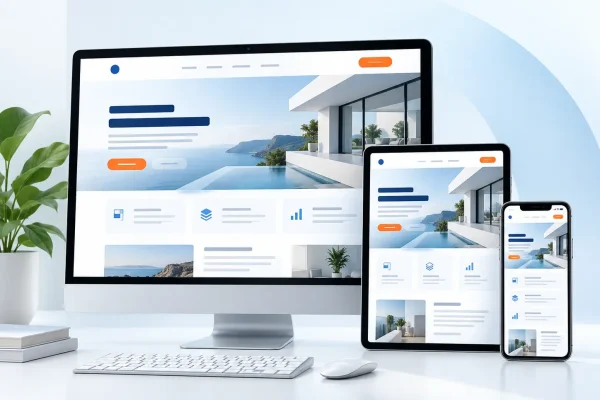
If you are comparing broader service options, explore our website design services in the USA to understand how custom design fits into a complete website project.
Strategic Approach
Built around your business goals
Responsive Design
Looks great on every device
SEO-Friendly Structure
Built for long-term visibility
Business-Focused UX
Designed to convert visitors
What Are Custom Website Design Services?
Custom website design is the process of planning and creating a website around a specific business rather than starting with a fixed design and changing only its colors, images, and text. The process considers the brand, target audience, required pages, content priorities, conversion goals, functionality, and future growth requirements.
The word “custom” should not simply mean that a template has been edited. A genuinely customized website has a page structure, visual hierarchy, content flow, and feature set selected for the organization using it. The extent of customization may vary by project, but the decisions should be connected to clear business and user requirements.
Custom Website Design vs. Prebuilt Templates
A prebuilt template can be useful when a business needs a simple website quickly and has limited requirements. Templates provide an existing layout, which can reduce the amount of initial design work. However, the business may have to adapt its content and customer journey to sections that were created for a general audience.
Custom web design services take the opposite approach. The website structure is planned after reviewing what visitors need to learn, compare, or complete. This makes it possible to prioritize the most important services, create clearer navigation, and place calls to action where they naturally support the decision-making process.
Neither approach is automatically right for every project. The appropriate choice depends on the website’s purpose, required functionality, available budget, timeline, and expected growth.
What Makes a Business Website Truly Custom?
A custom business website should reflect more than brand colors. Its page architecture, menus, layouts, forms, content sections, and responsive behavior should work together as one system.
Important signs of meaningful customization include:
- Page layouts created around the business’s services and audience
- Navigation based on actual visitor priorities
- Visual hierarchy that makes important information easy to find
- Calls to action connected to different stages of the customer journey
- Responsive behavior planned for desktop, tablet, and mobile devices
- Functionality selected for genuine operational requirements
- A structure that can accommodate future pages, services, or integrations
When Does a Business Need a Custom Website?
A custom website becomes especially useful when a business has several services, a specialized sales process, multiple audience groups, appointment or enquiry requirements, third-party integrations, or plans to expand its content over time.
It may also be appropriate when an existing website looks generic, creates confusion, performs poorly on mobile devices, or makes important information difficult to find. In such cases, customization is not only a visual decision; it is an opportunity to improve the website’s organization and usability.
Business Benefits of a Custom Website
A custom website should not be treated as decoration. Its value comes from how effectively it communicates, guides visitors, supports business processes, and adapts as the organization changes.
Build a More Distinctive and Credible Presence
Businesses using the same popular templates can begin to look similar, even when their services are different. Custom website design creates more control over typography, spacing, imagery, page composition, and the way key messages are presented.
Consistency is particularly important. When the website’s design matches the company’s positioning and communication style, visitors receive a more coherent impression of the business. Clear service information, accessible contact options, and professionally organized pages can also make it easier for potential customers to evaluate the company.
Create Clearer Customer Journeys
Visitors rarely arrive with identical intentions. Some are learning about a problem, others are comparing providers, and some are ready to discuss a project. A custom website can support these different stages through purposeful navigation and content pathways.
For example, an early-stage visitor may need educational information, while a decision-ready visitor may need service details, pricing factors, FAQs, and an enquiry form. Planning these pathways reduces unnecessary friction and helps visitors locate an appropriate next step.
Prepare the Website for Future Growth
A website may begin with a focused set of pages and later require additional services, locations, resources, case studies, integrations, or campaign landing pages. A flexible architecture makes these additions easier to manage without repeatedly rebuilding the entire navigation system.
Custom website design and development can also account for the content management system, reusable page components, and technical structure required for ongoing expansion. Scalability does not mean adding every possible feature at launch. It means avoiding decisions that unnecessarily restrict future development.
What Our Custom Website Design Services Include
The exact deliverables should always be confirmed in the project scope. Depending on the business requirements, a custom website project may include the following areas.
Strategy and Information Architecture
The project begins by clarifying the business model, target audience, main services, website objectives, and required user actions. This information supports decisions about the sitemap, navigation, page priorities, and conversion paths.
Strategy may include:
- Business and audience discovery
- Existing website review
- Competitor and positioning observations
- Page and sitemap planning
- Navigation structure
- Content priorities
- Form and call-to-action planning
This stage helps prevent a common problem: designing individual pages before understanding how the full website should work together.
Custom UI/UX and Responsive Web Design
The interface should make the content easier to understand rather than competing with it. Custom UI/UX design considers page hierarchy, readable typography, brand consistency, spacing, interaction patterns, and the relationship between visual elements and user actions.
Responsive behavior is planned across common screen sizes so that navigation, text, images, forms, tables, and buttons remain usable. Mobile design should not be treated as a smaller desktop layout; priorities and spacing often need to adjust for a narrower screen and touch-based interaction.
Development, CMS, and Integrations
After the design direction is approved, the website is developed using an appropriate content management and technical setup. The scope may include reusable sections, forms, analytics, appointment tools, email integrations, ecommerce features, or other third-party systems.
Custom WordPress web design can be suitable for businesses that want practical control over pages and content after launch. Platform selection should nevertheless be based on requirements rather than familiarity alone.
Development should also consider semantic headings, crawlable navigation, image optimization, and maintainable page construction. Google’s SEO Starter Guide explains that useful content and a logical site organization help search engines and visitors understand a website. These foundations support SEO, but they do not guarantee rankings.
Ready for a Website Designed Around Your Goals?
Tell us what your business needs, and we’ll help define the right website structure, features, and next steps for your project.
Clear recommendations based on your requirements.
Our Custom Website Design Process
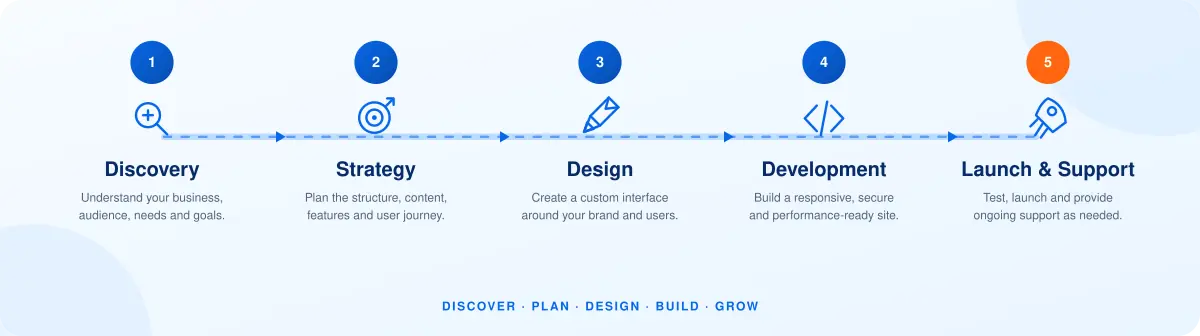
Our custom website design services follow a clear process that keeps creative and technical decisions connected to the approved requirements. The exact workflow may change according to project complexity, but the following stages provide a practical framework.
Discovery and Website Strategy
We begin by reviewing the business, audience, objectives, existing digital presence, required features, content availability, and project responsibilities. The goal is to understand what the website must accomplish before defining how it should look.
This stage may also identify missing information, unnecessary features, migration requirements, or decisions that need to be resolved before design begins.
Design, Development, and Review
The approved structure is translated into page layouts and a consistent visual system. Reviews should focus on whether the design communicates clearly, supports the intended user journey, and reflects the agreed direction.
Once the direction is approved, development begins. Responsive behavior, forms, navigation, reusable components, and integrations are implemented according to the defined scope. Feedback and revisions should follow an agreed process so that responsibilities remain clear.
Testing, Launch, and Support
Before launch, the website should be reviewed across relevant devices and browsers. Forms, buttons, menus, links, and other interactions need to be tested. Content, metadata, redirects, indexing settings, analytics, and basic performance considerations should also be checked where they are included in the scope.
After approval, the website can be launched. Ongoing support may cover maintenance, updates, new sections, technical improvements, or wider SEO and conversion work.
Custom Website Design for Different Business Models
The same page structure does not suit every organization. A professional services firm, local business, ecommerce store, and growing corporate company may need very different content priorities and functionality.
Small Business and Professional Service Websites
Custom websites for small businesses often need to explain services quickly, establish credibility, and make contacting the company straightforward. Service pages, location information, appointment options, FAQs, and trust-building content may be important.
Professional service websites may place greater emphasis on expertise, process, industries served, resources, and detailed enquiry forms. The design should help visitors understand both the service and the value of speaking with the provider.
Corporate and Multi-Service Websites
Corporate and multi-service websites commonly require deeper navigation, multiple audience pathways, resource sections, team or company information, and a structure that can accommodate ongoing content additions.
Information architecture becomes especially important as the number of pages grows. Clear grouping and internal linking help prevent important services from becoming buried within the site.
Ecommerce and Feature-Rich Websites
Ecommerce projects need careful planning around product discovery, categories, filters, product information, cart behavior, checkout, account features, and integrations. Because this is a specialized requirement, detailed ecommerce design and development should be scoped separately rather than added as a small feature to a standard business website.
SEO, Performance, and Conversion Considerations
SEO, performance, and conversion planning should influence the website from the beginning. Treating them as last-minute additions can create unnecessary rework.
SEO-Aware Website Structure
An SEO-aware foundation includes descriptive page topics, a logical hierarchy, useful internal links, indexable content, sensible URLs, and headings that accurately describe each section. It should also prevent important pages from competing for the same primary keyword.
For a broader explanation of planning, processes, and website resources, visit our handbook for website design services.
Mobile Usability and Performance
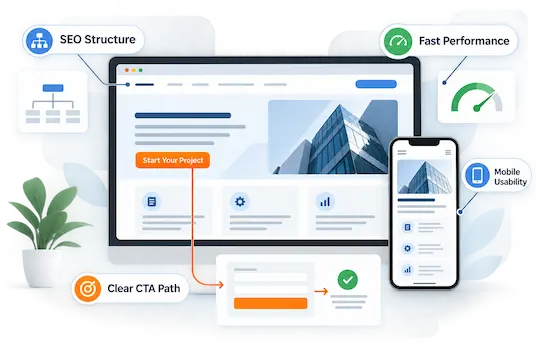
Responsive layouts, appropriately sized media, readable typography, and touch-friendly controls improve usability across devices. Performance-aware development also avoids adding unnecessary scripts, animations, plugins, and oversized images merely for visual effect.
Core Web Vitals and other performance measurements should be evaluated in the context of the completed page. A visually simple page can still perform poorly if it loads excessive code, while a well-optimized visual page may remain efficient.
Conversion-Focused Page Planning
A conversion-focused website makes important information easy to find and guides visitors toward a relevant next step without overwhelming them with unnecessary buttons.
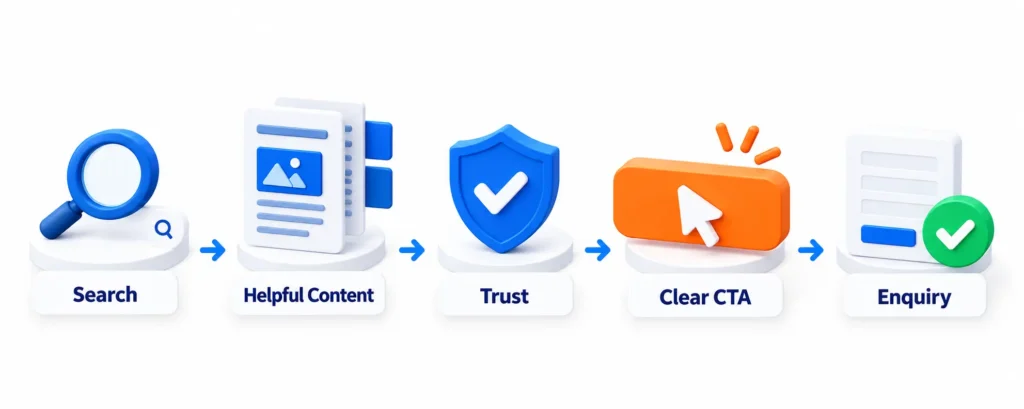
We plan calls to action around the visitor’s journey—from initial service exploration and educational resources to project-scope discussions and the final enquiry form. Clear button wording helps visitors understand what will happen after they click.
Custom Website Design Cost and Project Scope
Custom website design cost depends on the work required rather than one universal figure. Publishing an attractive starting price without defining the scope can create confusion about what is included.
Factors That Influence Custom Website Design Pricing
Common pricing factors include:
- Number and complexity of pages
- Level of visual customization
- Content creation or migration
- Forms and conversion requirements
- Ecommerce or membership functionality
- Third-party integrations
- Custom programming
- Testing and accessibility requirements
- Training, maintenance, and post-launch support
Businesses comparing custom web design pricing should request a written scope that connects the cost to specific deliverables.
What Should Be Included in the Quotation?
A clear quotation should identify the pages, functionality, design deliverables, revision limits, content responsibilities, integrations, expected timeline, ownership arrangements, post-launch support, and exclusions.
It should also explain which requirements depend on third-party subscriptions, hosting, premium plugins, payment providers, or external services. This makes proposals easier to compare and reduces surprises later.
How to Choose a Custom Website Design Company
The right provider should be able to explain both the creative direction and the practical project process. A strong sales presentation is not a substitute for a clear scope.
Questions to Ask Before Hiring
Ask potential providers:
- How will you learn about our business and audience?
- Which deliverables are included?
- How will responsive behavior be reviewed?
- Who provides and approves the content?
- How many review stages are included?
- Which SEO foundations are addressed during development?
- Who owns the website and design assets?
- What support is available after launch?
Warning Signs to Consider
Be cautious when a provider cannot explain the process, avoids documenting the scope, relies heavily on copied layouts, or leaves ownership and post-launch responsibilities unclear. You should also question guaranteed ranking claims because Google clearly states that no one can guarantee a #1 search ranking.
Low pricing is not automatically a warning sign, and a high price is not proof of quality. The important question is whether the proposed approach matches the business requirements and clearly defines what will be delivered.
Why Choose Digital Zone Consulting?
Digital Zone Consulting approaches custom website projects as a combination of strategy, content structure, design, responsive development, SEO awareness, and conversion planning. Recommendations are shaped around the defined requirements rather than a fixed list of features every business is expected to purchase.
Business-Focused Planning
We consider what your visitors need to understand, which pages support important services, and where an enquiry or appointment becomes a natural next step.
Clear Scope and Communication
Project requirements, responsibilities, and deliverables should be discussed before development begins. Clear reviews and approvals help keep the work aligned with the agreed direction.
Support for Future Improvements
As business needs evolve, the website may require new pages, updated messaging, performance improvements, SEO support, conversion testing, paid campaign landing pages, or integrations. Our USA website design guide explains the essential considerations for planning and improving a business website. These requirements can be evaluated as separate improvements instead of adding unnecessary complexity to the initial launch.
Frequently Asked Questions
Find clear answers about our custom website design services, development process, functionality, and ongoing support.
What are custom website design services?
Custom website design services create a website around a business’s goals, audience, content, functionality, and brand instead of relying on a pre-built layout with limited customization.
How long does a custom website take?
The timeline depends on the number of pages, required features, content readiness, integrations, feedback, and approval process. A clear project scope helps establish a realistic schedule before development begins.
Will my website be mobile-friendly?
Yes. Responsive design allows the website’s layout, navigation, content, images, and calls to action to adapt across desktop, tablet, and mobile screen sizes.
Can you help with website content and SEO?
Digital Zone Consulting can plan an SEO-aware page structure, headings, internal links, content sections, metadata considerations, and conversion pathways. Search rankings cannot be guaranteed by design alone.
Do you only design WordPress websites?
The appropriate platform depends on your content, functionality, management needs, integrations, and long-term plans. These requirements should be reviewed before recommending a suitable solution.
Can third-party tools be integrated?
Integrations may include forms, analytics, appointment systems, payment tools, email platforms, CRM software, social channels, or other business applications, depending on compatibility and project scope.
What happens after the website is launched?
Post-launch requirements may include monitoring, updates, security checks, backups, content changes, technical maintenance, and performance improvements. The required support can be defined within the project scope.
How do I start my website project?
Begin by sharing your business goals, target audience, required pages, preferred features, existing website details, and available content. We can then discuss the appropriate scope and next steps.
Still have a question about your website?
Share your requirements and discuss the next step for your custom website project.
Let’s Build Something Valuable
Start Your Custom Website Design Project With Digital Zone Consulting
A custom website should reflect your business, communicate clearly, and provide a practical foundation for future growth. If you are planning a new website or replacing an outdated one, Digital Zone Consulting can help you clarify the structure, functionality, design direction, and project scope. .
- ✓Requirement-focused discussion
- ✓Clear scope recommendations
- ✓Responsive design planning
- ✓Confidential project details
Tell Us About Your Website
Submitting the form opens WhatsApp with your entered details. Your message is sent only after you confirm it in WhatsApp.