
Logo Design Trends in the USA: 2026 Trends for Modern Businesses
Logo design is changing as brands adapt to digital platforms, new technologies, and increasingly flexible visual identities. Businesses exploring logo design services in the USA are also looking for identities that can work across modern digital and physical brand environments. In 2026, modern logo design is moving beyond the idea of a logo as a single, fixed graphic. Designers are increasingly exploring adaptable systems, expressive typography, motion, dimensional effects, geometric forms, and AI-assisted creative workflows.
The latest LogoLounge trend report is particularly useful for understanding this shift. Bill Gardner’s 2026 report reviewed more than 30,000 logos and identity systems from significant projects worldwide, identifying 15 emerging visual patterns. The report is global rather than exclusively focused on US businesses, but many of the identified directions are highly relevant to companies operating in the US market.
At the same time, Adobe’s 2026 research, based on a survey of 285 professional graphic designers, highlights memorability, creativity, legibility, digital adaptability, expressive typography, tactile design, kinetic logos, and AI-assisted approaches as important parts of the current logo-design conversation.
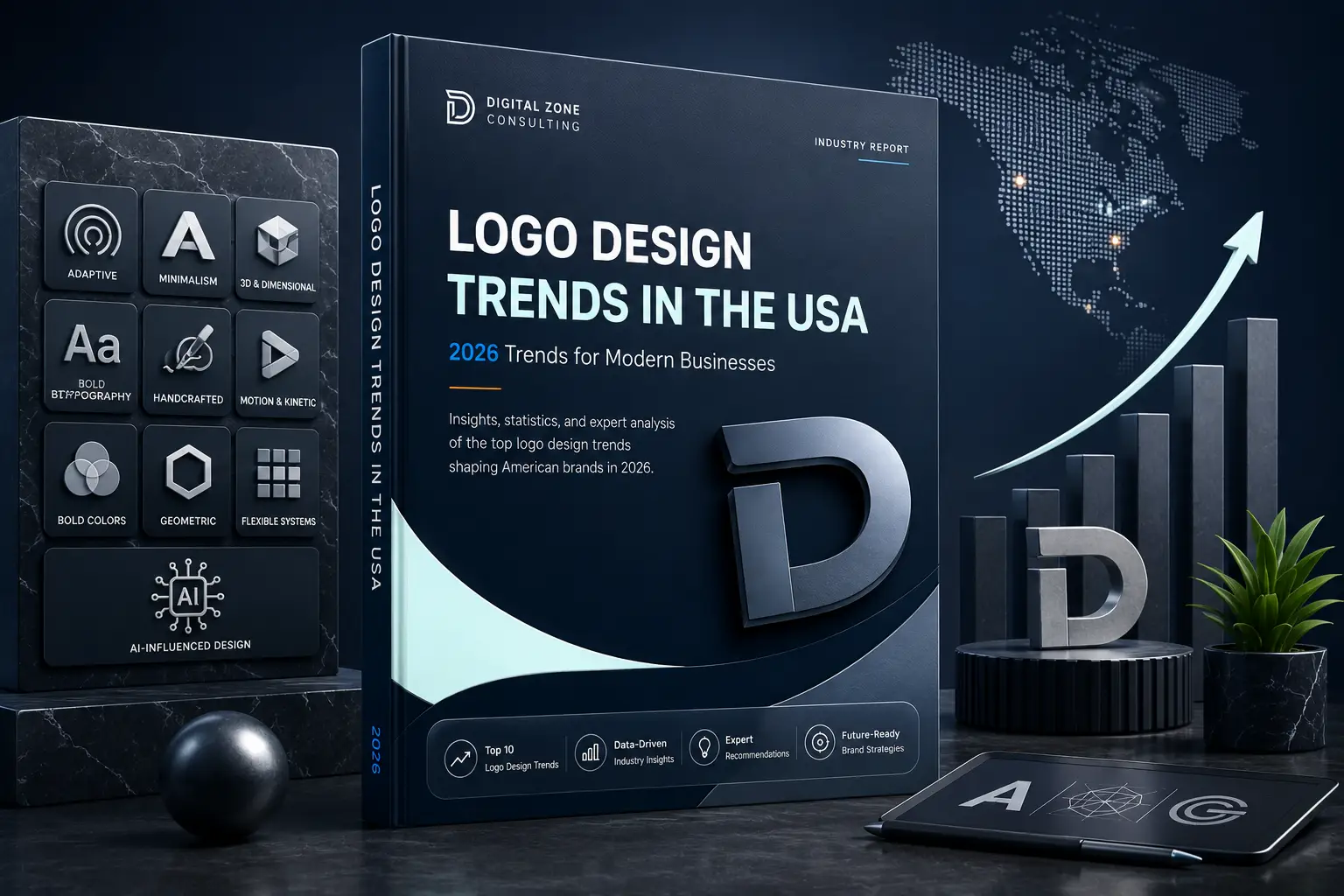
For businesses, however, following a trend should never be the entire design strategy. A professional logo still needs to represent the brand, remain recognizable, work across applications, and support the company’s identity over time.
What Are the Biggest Logo Design Trends in the USA in 2026?
Why Logo Design Trends Matter to US Businesses
Logo design trends give businesses insight into how visual identities are evolving. They can help companies understand what contemporary branding looks like and identify design approaches that may be appropriate for their audience and industry.
Adobe’s 2026 research found that 80% of surveyed designers prioritize industry relevance and brand identity when creating logos. The same research identified memorability, creativity, and legibility as important characteristics of effective logo design.
This is why trends should be treated as a source of direction rather than a requirement. A business logo does not become effective simply because it resembles what is currently popular.
For US businesses competing across websites, social media, mobile interfaces, packaging, signage, and other brand touchpoints, the better approach is to identify current design movements and determine whether they support the company’s own positioning.
How Digital Branding Is Changing Logo Design
Digital platforms have changed what businesses need from their logos. A mark may appear as a small social-media avatar, mobile icon, website header, advertisement, presentation, packaging element, or large-format graphic.
This has increased the importance of adaptability and legibility. Adobe reports that more than 30% of surveyed designers had simplified a logo during the previous year specifically to improve digital adaptability.
The 2026 LogoLounge report describes a broader movement toward identities that are less fixed and more fluid. Designers are increasingly developing systems that can change, respond, and produce different expressions while maintaining a recognizable visual language.
Why Businesses Need More Than a Trendy Logo
A trendy logo can look contemporary, but visual popularity alone does not create a strong brand identity.
A business needs a logo that communicates something relevant about the organization and remains usable beyond the moment when a particular design style becomes popular. Adobe similarly cautions against adopting trends at the expense of brand personality and identity.
LogoLounge makes a similar distinction: its trend report identifies where design is moving rather than telling designers to simply copy those directions.
For that reason, modern custom logo design should use trends selectively while keeping the individual business at the center of the design process.
10 Logo Design Trends Shaping US Businesses in 2026
Adaptive and Responsive Logo Design
One of the clearest directions in modern branding is the movement toward adaptable identities.
Instead of relying on one version of a logo for every situation, businesses can use coordinated variations that respond to different sizes, environments, and digital applications. This can be particularly useful when the same brand needs to work across a desktop website, mobile screen, social profile, packaging, and physical signage.
LogoLounge describes the current movement as increasingly fluid, with brands able to flex and adapt rather than remaining completely static. Wix’s 2026 trend analysis similarly identifies adaptive logos as an important direction in contemporary branding.
Neo-Minimalism With More Brand Personality
Minimalism remains important, but 2026 is not simply about removing every possible design element.
The emerging approach can be understood as neo-minimalism: simplified forms combined with enough personality to prevent the identity from becoming anonymous.
Adobe identifies ultra-minimalism as a major direction while also noting the risk of sacrificing personality through excessive simplification. Wix likewise identifies neo-minimalism as an important 2026 logo trend.
For a business logo, the goal is therefore not minimalism for its own sake. It is to remove unnecessary complexity while preserving a distinctive visual character.
Dimensional and 3D Logo Design
Three-dimensional visual treatments are another notable direction in 2026.
LogoLounge reports that advanced rendering tools and AI are contributing to an increase in three-dimensional imagery across icons, logos, and visual elements. Its Faders and Roll Over trends demonstrate different approaches to creating depth, curvature, gradients, and tactile richness.
Dimensional design can give a brand a richer digital presence, particularly in environments where lighting, gradients, rendering, and animation can be controlled.
However, a dimensional treatment should not replace a usable core logo. Businesses still need versions that remain clear when reproduced in simpler formats.
Bold Typography and Custom Wordmarks
Typography is playing a major role in current logo design.
LogoLounge’s Slip Knots trend explores expressive letterforms where an individual letter can become an independent visual element. Its Slant Break trend uses an italic or slanted character within a wordmark to introduce distinction and movement.
Adobe’s 2026 research also identifies expressive typography as part of the current design landscape.
This creates opportunities for custom logo designers to develop wordmarks that are more distinctive than simply selecting a standard typeface and typing the company name.
Handcrafted and Human-Centered Logo Styles
As AI-generated and highly polished digital imagery becomes more common, human and tactile qualities can provide another direction for brand identity.
Adobe identifies tactile digitalism and human-centered design among its 2026 logo trends.
The appeal is not necessarily imperfection for its own sake. Rather, handcrafted qualities can introduce warmth, individuality, and a more human visual character.
For brands whose personality depends on authenticity, creativity, craftsmanship, or personal connection, this direction may be more appropriate than a highly technical aesthetic.
Motion and Kinetic Logo Design
Motion is becoming increasingly important to digital identity systems.
LogoLounge’s Phasers trend represents movement through separate stages or positions rather than simply showing a smooth continuous rotation. The report also describes movement as a broader characteristic of contemporary identity systems.
Adobe identifies kinetic logos as another 2026 direction, while Wix highlights kinetic typography and dynamic identity systems.
A business does not necessarily need an animated logo everywhere. Instead, motion can become an additional layer of the identity for websites, videos, social content, presentations, and other digital applications.
Bold Color Combinations and Strategic Color Use
Motion is becoming increasingly important to digital identity systems.
LogoLounge’s Phasers trend represents movement through separate stages or positions rather than simply showing a smooth continuous rotation. The report also describes movement as a broader characteristic of contemporary identity systems.
Adobe identifies kinetic logos as another 2026 direction, while Wix highlights kinetic typography and dynamic identity systems.
A business does not necessarily need an animated logo everywhere. Instead, motion can become an additional layer of the identity for websites, videos, social content, presentations, and other digital applications.
Geometric and Simplified Logo Forms
Simple geometric components remain highly useful in contemporary logo design.
LogoLounge’s Colorforms, Quad Quivers, Open Axis, and Tri-Link trends demonstrate different ways designers are combining geometric components, negative space, directional forms, and interconnected elements.
The strength of geometric construction is its flexibility. Simple shapes can often be reproduced across different sizes and applications while providing a clear visual foundation.
For modern businesses, however, geometric simplicity needs an original concept. Generic circles, squares, arrows, and abstract forms can easily become interchangeable without distinctive strategic thinking.
Flexible Logo Systems for Multiple Platforms
The modern brand identity increasingly extends beyond one logo file.
LogoLounge describes designers moving toward frameworks and toolkits that allow clients to adjust visual outputs while remaining within a defined brand language. Its example of Koto’s work for MassiveMusic demonstrates how a generative visual system can translate sound into visual expression while preserving brand integrity.
This reflects an important development in professional logo design: businesses may need a coordinated identity system rather than one isolated mark.
A flexible system can include a primary logo, simplified mark, icon, typography, color system, and other supporting elements designed to work together.
AI-Influenced Logo Design With Human Creative Direction
AI is now influencing the logo-design process, particularly through image generation, rendering, experimentation, and visual exploration.
LogoLounge identifies the continued surge of AI and advanced rendering tools as an important factor behind current visual developments, including increasingly dimensional imagery.
Adobe’s 2026 research also identifies AI-assisted approaches among current logo-design directions.
But AI does not eliminate the need for creative direction. A professional designer still has to determine whether an idea fits the brand, whether it is distinctive, whether the mark is usable, and how it should function across real applications.
That human judgment is particularly important when many AI-generated visual solutions can begin to look similar.
Logo Design Trends by Business Type
Logo Trends for Technology and SaaS Companies
Technology and SaaS brands can potentially benefit from adaptable identities, dimensional graphics, motion, and geometric systems.
The Faders trend described by LogoLounge is particularly relevant to digital products because its visual language uses contained geometric structures, gradients, monoline pathways, and an appearance associated with applications and underlying digital systems.
A technology logo does not need to look futuristic simply because the company uses technology. The stronger approach is to select visual characteristics that communicate the company’s actual positioning.
Logo Trends for Professional Services
Professional-service businesses often need a balance between credibility and distinctiveness.
Neo-minimalism, refined typography, restrained geometry, and carefully selected color can provide a contemporary identity without making the brand unnecessarily experimental.
Adobe’s emphasis on brand identity, industry relevance, memorability, and legibility provides a useful foundation for this approach.
Logo Trends for Retail and E-Commerce Businesses
Retail and e-commerce brands operate heavily in digital environments, making adaptability and recognition particularly important.
A logo may need to function on websites, mobile interfaces, social profiles, packaging, product labels, and promotional materials. Flexible logo systems, strong typography, simplified forms, and strategic color can therefore be useful design directions.
The specific trend should still depend on the brand’s personality and target audience rather than simply following whatever aesthetic is currently popular.
Logo Trends for Restaurants and Hospitality Brands
Restaurants and hospitality businesses can explore expressive typography, handcrafted qualities, bold color, and distinctive visual forms when those characteristics fit their positioning.
The human-centered and tactile direction identified by Adobe may be particularly appropriate for brands where atmosphere, personality, and personal experience are important parts of the customer relationship.
Logo Trends for Startups and Small Businesses
Startups and small businesses need a logo that can grow with the business.
A flexible identity can be particularly useful because a new company may initially rely heavily on digital channels before expanding into packaging, signage, advertising, events, or other applications.
Rather than choosing a design purely because it looks modern, a startup should consider whether the identity can remain recognizable as the business develops.
How to Choose the Right Logo Design Trend for Your Business
Consider Your Target Audience
The most attractive trend is not necessarily the most appropriate trend.
Consider who needs to recognize the brand, what they expect from the industry, and what visual qualities support the company’s positioning.
Adobe’s research reinforces the importance of industry relevance and brand identity when developing logos.
Match the Logo With Your Brand Personality
A technology startup, law firm, restaurant, fashion company, and healthcare business may all need completely different visual personalities.
A current trend should therefore be adapted to the brand rather than copied literally.
A professional logo designer can use the same broader design movement differently depending on the company’s personality and communication goals.
Prioritize Recognition Over Popularity
A logo’s job is not simply to look current.
Adobe’s 2026 survey found memorability was identified by 44% of respondents, compared with 33% for creativity and 32% for legibility among the listed successful-logo attributes.
That makes recognition an important consideration when evaluating any trend.
Make Sure the Logo Works Across Digital and Print
A logo should be tested in the environments where the business will actually use it.
That can include websites, mobile screens, social-media profiles, printed materials, signage, packaging, and other brand applications.
Adobe’s guidance emphasizes the need for logos to remain usable across different sizes and digital contexts.
Consider Long-Term Brand Use
Before adopting a trend, ask whether the design will still make sense when the trend becomes less fashionable.
A strong logo can evolve with its industry without needing to be redesigned every time the visual landscape changes.
The objective should be a brand identity that can use contemporary design language without becoming dependent on it.
Should US Businesses Follow the Latest Logo Design Trends?
When Following a Trend Makes Sense
Following a trend can make sense when it supports the brand and solves a genuine communication or usability need.
For example, an adaptive approach may help a business operate across multiple digital contexts, while a simplified structure may improve usability at small sizes.
The trend becomes valuable when it serves a purpose.
When a Trend Can Hurt Brand Recognition
A trend can become a problem when it makes a business look interchangeable with competitors.
Excessive simplification can remove personality, while overly complicated treatments may reduce usability. Adobe specifically discusses the tension between simplicity and maintaining brand personality.
AI-driven design also introduces another challenge: visual similarity. Current discussions around AI branding have highlighted concerns about companies converging around similar visual languages.
Trendy Design vs Timeless Brand Identity
The best approach is not to choose between “trendy” and “timeless” as if they are opposites.
A business can use contemporary design techniques while maintaining a distinctive core identity.
LogoLounge’s own conclusion is useful here: its trends represent movement in the design industry, but designers should build on those developments rather than simply mimic them.
What Makes a Professional Logo Design Effective in 2026?
Distinctive and Memorable Design
A professional logo should give people something distinctive to remember.
Current trends can provide inspiration, but the underlying concept still needs to belong to the individual brand.
Adobe’s survey finding that memorability was selected by 44% of respondents reinforces why recognition should remain central to logo development.
Scalability and Versatility
Modern logos need to operate across a wide range of sizes and environments.
A mark may appear as a tiny mobile icon one moment and a large printed graphic the next. Simple, carefully constructed forms can make this easier.
Vector-based logo development is particularly useful because vector artwork can be scaled without losing image quality.
Consistent Brand Application
A logo becomes more powerful when it works as part of a consistent visual identity.
The movement toward flexible frameworks described by LogoLounge demonstrates how professional identity design is increasingly concerned with systems rather than isolated assets.
This can give businesses greater flexibility while maintaining recognizable visual characteristics.
Professional Design Strategy
Professional logo design involves more than producing attractive artwork.
The process should consider the brand, audience, industry, visual differentiation, typography, color, applications, scalability, and long-term use.
That strategic foundation allows a professional logo designer to decide which trends are useful and which should be ignored.
How Professional Logo Designers Use Trends Without Making Logos Look Generic
Combining Trends With Brand Strategy
Experienced logo designers can study current trends without allowing those trends to dictate the entire creative direction.
A designer might borrow the adaptability of current identity systems, the expressive qualities of contemporary typography, or the dimensional possibilities of advanced rendering while creating a completely different visual solution for the client.
LogoLounge’s 2026 report essentially makes this distinction: trends indicate where visual language is moving; they are not instructions to reproduce the same aesthetic.
Creating Custom Rather Than Template-Based Designs
The value of custom logo design lies in making design decisions around the specific business.
Templates and generic visual conventions can provide starting points, but a custom logo can be developed around the company’s name, positioning, audience, personality, and applications.
This is particularly relevant in an environment where AI-assisted tools make it easier to generate large numbers of visual concepts. Human creative direction remains important for deciding which concepts actually belong to the brand.
Building Logos for Real Business Applications
A professional logo should be created with real-world use in mind.
That means considering how it will appear on a website, social profile, mobile interface, printed material, packaging, signage, advertisements, and other relevant touchpoints.
The growing emphasis on adaptive and flexible identity systems reflects this broader shift.
The strongest business logo design is therefore not simply an attractive symbol. It is a practical identity asset that can operate consistently across the places where customers encounter the brand.
Final Thoughts on Logo Design Trends in the USA
The Best Logo Trend Is the One That Supports the Brand
The 2026 logo landscape is becoming more flexible, expressive, dimensional, and system-oriented.
LogoLounge’s analysis of more than 30,000 global logos and identity systems shows a design environment where movement, adaptable systems, expressive typography, geometry, dimensionality, color, and AI-assisted tools are influencing contemporary work.
Adobe’s research points toward a similar need for memorability, creativity, legibility, relevance, digital adaptability, and human creative input.
For US businesses, the lesson is straightforward: use trends as inspiration, not as a substitute for brand strategy.
A modern logo should look appropriate for its time, but it should also look unmistakably like your business.
Why Businesses Should Think Beyond 2026
Logo design trends will continue to change as technology, platforms, consumer expectations, and creative tools evolve. Adobe’s 2026 logo design research also highlights the importance of balancing modern design trends with brand identity and digital adaptability.
That makes adaptability increasingly valuable. Instead of designing a logo that works only for today’s aesthetic, businesses should consider whether their identity can evolve while preserving its recognizable foundation. For businesses exploring professional logo design services, this means choosing a design approach that can support the brand across different platforms and over the long term.
Whether a company needs a custom logo designer, professional logo designer, or experienced logo design team, the objective should remain the same: create an identity that is distinctive, versatile, strategically appropriate, and capable of supporting the brand well beyond a single design trend.
The best logo is not the one that looks the most like 2026. It’s the one that makes the brand look like itself—at its best.
The best logo is not the one that looks the most like 2026. It’s the one that makes the brand look like itself—at its best.
Ready to Discuss Your Logo Project?