Explore custom logo design services for your new business.
How to Choose a Logo for a New LLC in the USA
A practical guide to choosing a logo that represents your new limited liability company, works across business materials, and accounts for important US trademark and ownership considerations.
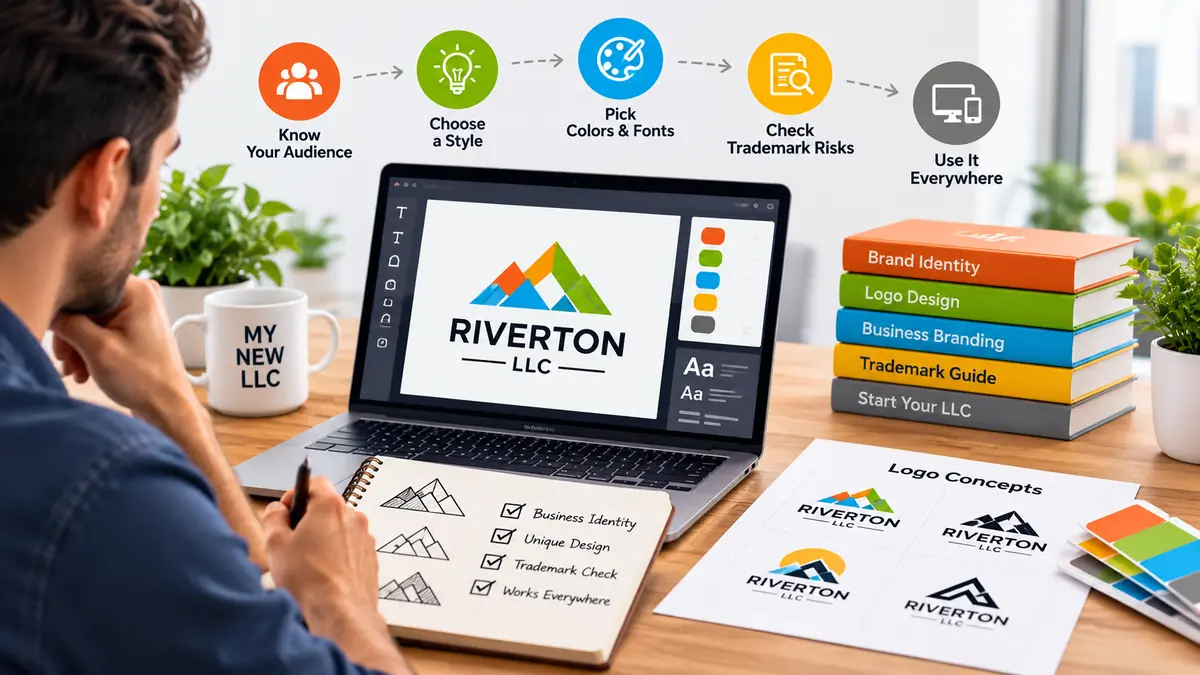
Starting a limited liability company (LLC) means making decisions that will affect how your business operates and how customers recognize it. You need a name, a clear idea of what you sell, and a way to present your company to the people you want to reach. Your logo is part of that process.
But choosing a logo for a new LLC raises questions that aren't always answered by browsing design templates. Should the logo include “LLC”? Can you use a symbol another business already uses? What happens if a freelance designer creates your artwork? And how much should a newly established business spend?
These questions matter because a logo isn't simply an image you upload to your website. It may eventually appear on invoices, storefronts, employee clothing, packaging, advertisements, and products. Replacing it after customers have become familiar with your business can mean updating many different materials.
There's also a legal distinction worth understanding. Registering an LLC does not automatically give you exclusive trademark rights to its name or logo. The US Small Business Administration explains that entity names, trademarks, doing-business-as (DBA) names, and domain names serve different purposes.
This guide will help you evaluate logo styles, make practical design decisions, understand trademark and ownership considerations, and choose an appropriate design service for your new American business.
What You'll Learn in This Guide
- How to select a logo that fits your LLC's customers and industry.
- Which logo styles, colors, and typography to consider.
- Whether the letters LLC should appear in your logo.
- How to investigate trademark conflicts.
- What to check before hiring a professional designer.
- How to compare logo design costs and deliverables.
Why Does a New LLC Need a Professional Logo?
Imagine opening a residential cleaning LLC in Charlotte, North Carolina. You have purchased supplies, arranged transportation, created a website, and started accepting inquiries.
Your first customer receives an estimate bearing one company name and font. Your social media page uses a different image. Your business card has another color scheme.
None of these differences necessarily says anything about the quality of your cleaning service. However, they make it harder to present one consistent identity.
A logo gives your business a common visual reference that can appear wherever you communicate with customers.
Business Identification
When someone sees the same mark on your website, invoices, and business vehicle, they have a visual element they can associate with your company.
Consistent Presentation
A logo provides a starting point for decisions about colors, typography, business stationery, and branded materials.
Business Differentiation
A carefully developed mark can help customers distinguish your LLC from businesses using similar names or imagery.
Future Applications
Artwork prepared in appropriate formats can be reused on additional materials as your business develops.
You don't need an elaborate illustration to accomplish these goals. A clearly typeset business name may be sufficient for some LLCs. Others may benefit from a symbol or a combination of text and graphics.
It's also important not to expect too much from a logo alone. A polished design cannot replace reliable service, accurate information, fair business practices, or responsive customer support.
The practical goal is to create a visual identity that accurately represents the company you're building.
How to Choose the Right Logo for Your New LLC
Choosing a logo becomes easier when you make a few business decisions before reviewing design concepts.
Instead of starting with a favorite color or symbol, think about the circumstances in which customers will encounter your LLC.
A plumbing company that advertises on service vehicles has different requirements from a software consulting firm that primarily communicates through websites and presentations. Both need readable, recognizable designs, but the applications may influence the final approach.
Identify Your LLC’s Brand Personality and Target Customers
Begin with a simple description of your company.
Suppose you're establishing a bookkeeping LLC in Austin, Texas. Your customers will be independent contractors and small business owners who need monthly accounting assistance.
A logo built around highly decorative lettering may not be the most practical choice for this audience. A readable business name with restrained typography could be more appropriate.
Now consider a business selling handmade children's clothing. Its customers, products, and marketing materials are different, so its visual direction may also be different. Neither approach is automatically better.
- What does your LLC sell or provide?
- Who is most likely to purchase its products or services?
- Where do those customers live or operate?
- Which qualities should the company communicate?
- What makes the business different from direct competitors?
- Where will the logo appear most often?
Your answers should be specific. Instead of describing your business as simply “professional,” explain what that means in your industry.
A residential electrician might want to communicate careful workmanship and reliability. A wedding photography business may prefer a more personal visual style.
Then examine the businesses your customers already know. Look for repeated symbols, similar lettering, and common color combinations. Notice whether competing logos are easy to identify at a glance.
This exercise isn't about following competitors. It helps you recognize design choices that may make your LLC look too similar to another company.
Choose the Right Logo Style, Colors, and Typography
There are several ways to represent a business visually. Understanding the basic approaches can help you evaluate concepts without getting distracted by decorative details.
Wordmark
Uses the company's name as the principal design element. It may suit an LLC with a short, memorable name. Typography, letter spacing, and readability are important.
Lettermark
Uses initials or abbreviated lettering. It can help simplify a lengthy business name, although new customers may still need to see the full name.
Symbol-Based Logo
Uses an illustration, abstract shape, or recognizable graphic. New businesses may need to display their company name alongside the symbol until it becomes familiar.
Combination Mark
Combines lettering and a symbol. The full version may work on a website while a simplified element can fit smaller applications.
Once you've selected a direction, examine the colors. Avoid choosing a color solely because a chart claims it always represents a particular emotion. Color interpretation depends on context, surrounding design, and the audience.
Instead, ask whether your selected palette works with your company's identity and can be reproduced consistently.
For typography, begin with readability. A font that looks attractive at a large size may become difficult to recognize when printed on a small business card.
Consider how the lettering appears in uppercase and lowercase, how much space the business name occupies, and whether unusual letterforms could cause confusion.
If your LLC has a long name, ask the designer to test more than one arrangement.
Test Your Logo Across Websites, Social Media, and Print
A logo should be evaluated in its intended applications, not only on a presentation slide.
For example, a detailed illustration might look excellent on a large sign but become unrecognizable inside a small social media profile image.
Before approving the artwork, request examples showing it in realistic business settings.
- Test the design in your desktop website header.
- Review its appearance on mobile screens.
- Check a square social media profile version.
- Examine business cards and printed documents.
- Test light and dark backgrounds.
- Check a single-color version.
- Review uniforms, signage, or packaging if relevant.
Pay attention to details that may disappear when the artwork is reduced. Thin lines, tiny lettering, closely spaced shapes, and intricate patterns can cause problems.
For websites, logos are not subject to every minimum text-contrast requirement in the Web Content Accessibility Guidelines (WCAG). However, that exception doesn't make readability irrelevant. W3C guidance still supports considering sufficient contrast, particularly where a logo is used as an interactive element.
A useful approval test is to ask someone unfamiliar with your LLC to identify the business name from a realistic-size version of the logo. If they struggle to read it, revisit the design before paying for printed materials.
What Makes a Good LLC Logo in the USA?
There isn't a universal formula for designing a successful business logo. The needs of a restaurant, accounting practice, construction company, and online retailer can differ substantially.
However, several practical qualities are worth evaluating.
Clear Identification
Someone encountering the logo should be able to connect it with your company, particularly when the business is new.
Appropriate Detail
The design should contain enough information to establish its character without becoming difficult to reproduce.
Readable Lettering
Your business name should remain legible at the sizes you expect to use.
Flexible Arrangements
A horizontal logo may work for a website header, while a compact version may be useful for smaller spaces.
Distinctive Appearance
The logo should not unnecessarily resemble another business's mark, especially one used for related services.
Usable Files and Rights
Artwork should be delivered in appropriate formats, with clear ownership and commercial-use permissions.
Distinctiveness is particularly important because logo selection also involves trademark considerations.
The United States Patent and Trademark Office (USPTO) evaluates potential trademark conflicts using factors that include similarities between marks and the relationship between the relevant goods or services.
That means a design doesn't necessarily become acceptable simply because you change a color or adjust a small graphic detail.
A good LLC logo should therefore satisfy both practical design needs and an appropriate legal review.
Should Your LLC Logo Include LLC in the Design?
Your business may be registered under a name such as “Cedar Creek Landscaping LLC,” but that doesn't automatically settle how its logo should look.
There are two separate questions.
The first is what your state's law requires for your registered business name and its use in particular circumstances. The second is how you want to display your business identity in marketing materials.
An LLC's legal name generally must meet the naming requirements of the state where it is formed. These requirements often involve a designation identifying the entity as a limited liability company.
A logo, however, is a visual representation of the business. Its design may use the complete registered name or a shorter presentation, depending on the circumstances and applicable rules.
This hypothetical company might consider displaying its complete registered name or emphasizing “Cedar Creek Landscaping.” Before using a shortened version, it should determine whether assumed-name or DBA requirements apply.
The SBA explains that DBA requirements can differ by state and locality. It also distinguishes business-name registration from trademark protection.
From a design perspective, including LLC can sometimes make a long business name harder to arrange, particularly in small applications. But appearance should not override legal requirements.
Check the rules applicable to your state and intended business communications before deciding which version of the name to display.
How to Check Logo Availability and Trademark Risks
A logo can be visually appealing and still create problems if another business already uses a confusingly similar mark.
This is why trademark research should happen before you invest in signage, packaging, uniforms, and advertising.
LLC registration alone does not establish nationwide exclusivity over your business name or logo. Federal trademark protection operates under a different legal framework.
The USPTO explains that a likelihood-of-confusion issue may arise when marks are similar and the associated goods or services are related. Exact duplication is not necessary.
Search for Conflicting Logos and Trademarks
Begin with the USPTO's official trademark search resources .
Search the wording you intend to use, including reasonable variations in spelling and pronunciation. If your logo includes a distinctive symbol, investigate similar graphic marks as well.
Don't limit your research to exact matches. A proposed mark may raise concerns even when another company uses a different spelling or arrangement, depending on the overall similarity and commercial context.
- Search federal trademark records.
- Check state trademark and business-name databases.
- Review similar names and symbols in your industry.
- Investigate relevant marketplace uses.
- Compare the goods and services associated with similar marks.
- Consider professional legal advice where necessary.
The USPTO recommends considering sources beyond its federal trademark database because relevant rights may arise through actual commercial use.
A matching word used by an unrelated business does not automatically establish a conflict. Conversely, changing a few letters does not automatically eliminate one.
If the logo will support a substantial business investment, consulting a qualified US trademark attorney may be appropriate.
Federal registration is optional, but it can provide additional legal benefits. Businesses may develop certain trademark rights through use in commerce, while federal registration can provide broader protections and legal presumptions.
The USPTO's published base filing fee for qualifying Section 1 and Section 44 applications is $350 per class of goods or services, with possible additional fees. Verify current fees before filing.
Trademark filing expenses are separate from logo design fees.
Understand Logo Ownership and Commercial Usage Rights
When you hire someone to design your logo, don't assume that paying the invoice automatically transfers every intellectual property right to your LLC.
The US Copyright Office explains that copyright ownership generally begins with the creator of eligible original artwork unless an applicable exception or valid transfer changes ownership.
A design agreement should therefore address what happens to the completed artwork.
- Will copyright in the eligible final artwork be assigned to your LLC?
- Will the transfer be documented in writing?
- Are third-party fonts, illustrations, or templates included?
- Do any assets carry licensing restrictions?
- Can another designer modify the artwork later?
- Which editable and exported files will you receive?
Another important question concerns future modifications. If your company later hires a different designer to update its logo, you need to understand whether the original agreement permits that work.
The agreement should identify whether editable artwork, web-ready exports, alternative color versions, and any applicable brand guidelines are included.
Copyright ownership and trademark rights are not interchangeable. A company may need to consider both.
For more information, consult the US Copyright Office and the USPTO.
Need a Custom Logo for Your New LLC?
Explore Digital Zone Consulting's professional logo design services and request details about the design process, project scope, and available deliverables.
Explore Professional Logo Design Services →DIY Logo vs. Professional Logo Design Services for a New LLC
A newly registered LLC may not have a large design budget. You might still be paying formation expenses, purchasing equipment, setting up accounting software, or preparing your first website.
Under those circumstances, it's reasonable to ask whether you should create a logo yourself or hire someone. The answer depends on what your business needs from the design.
Consider a freelance consultant operating under a newly formed LLC. If most customer interactions happen through email and online meetings, a carefully prepared wordmark may meet the company's immediate requirements.
Now consider an LLC opening a neighborhood restaurant. Its logo may appear on exterior signs, menus, food packaging, uniforms, delivery materials, and online ordering platforms.
The restaurant may need a more extensive design process because the artwork must function in several environments.
Creating the Logo Yourself
Online tools let you experiment with typography, shapes, and colors. They may reduce initial expenses, but you should check commercial-use permissions, template licensing, and trademark-related restrictions.
Hiring a Freelance Designer
A freelancer may help turn a defined concept into finished artwork. Review completed projects, revisions, deliverables, and written ownership terms before hiring.
Working with an Agency
An agency may offer a structured process involving research, concepts, revisions, and final file preparation. Some also provide related brand and website design services.
Choosing the Right Approach
More services do not automatically mean a better result. Compare the provider's process, terms, and deliverables against your LLC's actual requirements.
If you're using a logo generator, read the applicable licensing terms before adopting the result as your permanent business identity.
The quality of freelance work varies, so examine actual projects rather than relying exclusively on promotional descriptions. Ask how concepts are developed and how revisions are handled.
An agency isn't automatically the best choice simply because it offers more services. The most appropriate provider is the one whose process, deliverables, and terms match your business.
How Much Does Logo Design Cost for a New LLC in the USA?
Logo design prices in the United States differ because providers aren't necessarily selling the same type of work.
A template-based logo, a commissioned wordmark, and a complete brand identity project may involve substantially different amounts of research, design, and preparation.
For a published pricing example, the online design platform 99designs has listed the following prices for its logo design contest packages:
| Package | Published Price |
|---|---|
| Bronze | $249 |
| Silver | $399 |
| Gold | $799 |
| Platinum | $1,050 |
These are historical published examples from one provider, not verified US industry averages. Confirm current packages and prices at 99designs.
When evaluating quotes, examine what you're paying for. A provider offering one design concept and limited revisions may quote differently from someone providing several original directions and an extensive set of final files.
The number of deliverables matters too. Your LLC may need a primary logo, a simplified version for small applications, black-and-white artwork, and vector files for printing.
Some providers include these items in standard packages. Others may charge separately.
Also ask about revisions. Changing spacing, adjusting colors, or refining typography may be treated differently from developing an entirely new design direction.
Confirm the total project cost, payment schedule, included revisions, ownership terms, and final deliverables. Trademark clearance and registration should be discussed separately rather than assumed to be included.
A less expensive package may be entirely suitable for a business with straightforward requirements. Another LLC may reasonably choose a larger project because it needs a coordinated identity across numerous applications.
How to Choose the Best Logo Design Services in the USA
Finding a logo designer isn't difficult. Finding a provider who understands your particular business requires more careful evaluation.
If you're comparing the best logo design services in the USA for your new LLC, start by defining what you expect the provider to deliver.
A business launching its first website may need a logo and a small set of visual guidelines. A company opening several retail locations may require a more extensive identity system.
Both can benefit from custom logo design services, but the project requirements are different.
You may choose a logo designer in the USA or a provider working remotely with American businesses. In either case, the provider should understand your target market, intended applications, and contractual requirements.
Evaluate a Logo Design Agency’s Portfolio and Experience
A portfolio should demonstrate more than the ability to produce attractive images. Examine whether the designer can create different visual solutions for different kinds of businesses.
For example, if every logo uses similar lettering and geometric symbols, ask whether that reflects the designer's specialty or a limited approach to concept development.
Look for projects involving companies with needs comparable to yours.
If you operate a construction LLC, examples involving contractors, equipment businesses, or other service companies may help you evaluate experience with practical applications.
If you're establishing a boutique or cosmetics business, examine whether the designer has created suitable work for retail packaging and product presentation.
Try to distinguish completed client projects from speculative concepts. Both can demonstrate design ability, but they provide different evidence of professional experience.
You should also ask how the provider approaches a new assignment. Does the process begin with questions about the business? Will you receive explanations for proposed concepts? Can you review realistic applications before approval?
Experienced logo designers should be able to discuss these decisions clearly. A portfolio doesn't guarantee that a provider will meet your expectations, but it provides a useful starting point.
Compare Custom Logo Design Services, Deliverables, and Ownership
When reviewing proposals from a logo design agency or an independent professional, compare the actual scope of work.
Two providers may advertise business logo design services while including very different deliverables.
Ask each provider to explain what happens from the initial consultation through final delivery. You should understand how many concepts will be presented, how feedback is handled, and when the project is considered complete.
The final package deserves particular attention. You may want scalable vector artwork for printing, a transparent-background PNG for digital use, and a simplified variation for social media.
You may also need a record of selected colors and typography so future marketing materials remain consistent. Discuss these requirements before work begins.
Logo Design Services for US Businesses
Digital Zone Consulting provides logo design and related digital services for businesses, including companies targeting customers in the United States.
New LLC owners can review the agency's professional logo design services and request details about the design process, project scope, and deliverables.
View Digital Zone Consulting Logo Services →Whether you work with Digital Zone Consulting, another USA logo design company, or an independent custom logo designer, obtain clear written terms before committing to a project.
Explore the Complete USA Logo Design Guide
Want to learn more about logo styles, typography, file formats, and the design process? Explore Digital Zone Consulting's broader logo design handbook for additional practical guidance.
Read the USA Logo Design Guide →Common Logo Design Mistakes New LLC Owners Should Avoid
A new LLC owner may have to make dozens of decisions before the business opens. It's understandable that logo design can become another item to complete quickly. However, several common decisions deserve closer attention.
Following a Trend Without a Reason
A fashionable design may not reflect the company's identity. Consider whether the style suits your products, services, and intended customers.
Trying to Show Every Service
A home improvement LLC providing painting, flooring, and remodeling doesn't necessarily need a separate symbol for every service.
Resembling a Competitor
Similar marks used for related goods or services can create trademark concerns. Investigate conflicts before committing to the artwork.
Ignoring Mobile Readability
A logo that looks clear on a desktop monitor may become difficult to read in a small website header.
Ignoring Font Licenses
Fonts and design assets may have licensing conditions. Confirm that the intended commercial uses are permitted.
Accepting Inadequate Files
A small raster image may not work for large signage. Request appropriate vector artwork and agreed exports.
Unclear Ownership Terms
Don't rely on verbal assumptions about copyright transfer or future modifications. Obtain a written agreement.
Printing Before Trademark Research
Replacing signage or printed labels can be costly. Conduct appropriate clearance research before significant production commitments.
These mistakes aren't limited to new businesses. Established companies encounter them too. Addressing them during your LLC's initial design process may help avoid unnecessary work later.
New LLC Logo Selection Checklist
Before approving your new logo, review the following questions.
| Area | What to Confirm |
|---|---|
| Business Identity | Does the logo suit your LLC's products, services, and customers? |
| Company Name | Is the wording correct and consistent with applicable naming requirements? |
| Distinctiveness | Have you investigated potentially conflicting marks? |
| Typography | Can customers read the name at realistic sizes? |
| Colors | Does the design remain clear in its intended applications? |
| Website Use | Have you tested the logo on desktop and mobile screens? |
| Printed Materials | Can the artwork be reproduced at the required sizes? |
| Licensing | Are fonts and third-party design elements appropriately licensed? |
| Ownership | Does the agreement explain copyright and commercial-use rights? |
| Deliverables | Have you received the agreed vector and raster files? |
| Future Use | Can the logo accommodate your foreseeable business needs? |
You don't need to complete every possible branding activity before launching your LLC.
However, you should resolve any legal, licensing, or technical questions that could prevent you from using the design as intended.
If you hire a designer, keep the approved artwork, invoices, agreements, and related correspondence together. This documentation may be useful when you update your website, order new materials, or work with another professional.
Frequently Asked Questions About LLC Logo Design
Does a new LLC legally need a logo in the USA?
A custom logo is not generally required to form an LLC. Business formation involves meeting applicable state requirements, including registration and naming rules. Logo design is a separate business identity decision.
Can I use a free logo for my LLC?
You may be able to use artwork created with a free logo tool, depending on its terms. Check commercial-use permissions, asset exclusivity, and any restrictions relevant to trademark use.
Should my logo include the letters LLC?
Not necessarily. Your registered business name must comply with applicable state requirements, but that doesn't automatically determine every aspect of your marketing logo. Check rules for using your legal name or a separate trade name.
Can two LLCs have similar logos?
Similar logos may create trademark concerns, particularly when the marks are confusingly similar and the businesses offer related goods or services. The USPTO evaluates more than exact visual duplication.
Should I trademark my LLC logo?
Federal trademark registration is optional. It may provide valuable legal benefits depending on how you use the mark and your business plans. Consider consulting a qualified US trademark attorney before filing.
Who owns a logo created by a freelance designer?
Copyright ownership generally begins with the creator of eligible original artwork unless an applicable exception or valid transfer changes ownership. Your agreement should clearly address the rights assigned or licensed to your LLC.
What logo file formats should a new LLC receive?
Many businesses benefit from vector artwork, such as SVG or EPS, alongside suitable raster exports such as PNG. The exact requirements depend on where the logo will be used and what your vendors accept.
Can I change my LLC logo after registering my business?
Yes, businesses can generally update their logos. However, a change may affect trademark filings or registrations, licensing arrangements, and existing business materials. Review relevant obligations before adopting a replacement.
Build a Professional Identity for Your New LLC
Your LLC's first logo doesn't need to be complicated. It needs to represent the business accurately and work wherever customers will encounter it.
Begin with your company name, audience, and intended applications. Consider the advantages of different logo styles, evaluate the typography, and test the design before approving it.
Don't overlook the legal details. State business-name registration, trademark rights, copyright ownership, and commercial licensing address different issues. Understanding those distinctions can help you make better decisions before investing in the finished artwork.
You can develop a logo independently or hire a professional. What matters is choosing a process that fits your company's needs and gives you the appropriate files and usage rights.
A carefully chosen logo gives your new company a consistent visual starting point—one you can continue using as your business develops.
References and Fact-Checking Sources
The following resources support the legal, design, and technical information discussed in this guide.
- US Small Business Administration — Launch Your Business : Business names, entity registration, trademarks, and DBAs.
- USPTO — Trademark Search : Searching for potentially conflicting marks.
- USPTO — Likelihood of Confusion : Similarity of trademarks and related goods or services.
- USPTO — Trademark Filing Fees : Published federal trademark application fees.
- US Copyright Office — Works Made for Hire : Copyright authorship and work-made-for-hire requirements.
- US Copyright Office — Copyright Basics : Copyright ownership and transfers.
- W3C — Understanding Contrast Minimum : Accessibility guidance and the logotype exception.
- 99designs — Pricing : Provider-specific logo design package pricing.
Editorial disclosure: This article provides general educational information, not legal advice. Trademark fees, provider pricing, and state-specific requirements can change. Verify applicable details before filing, purchasing, or publishing. Hypothetical business examples are illustrations, not client case studies.